
1
1
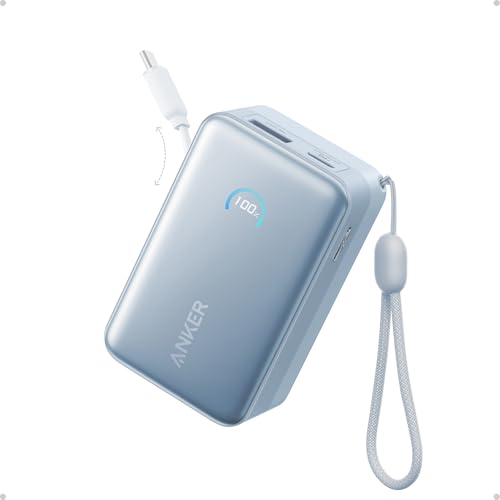
Ultra-compact power bank with built-in USB-C cable
Anker Nano Power Bank (10,000mAh)
Prime
The Good
- Built-in cable
- 30W fast charging
- Pocket-sized
The Bad
- 10,000mAh only
Free returns•Fast shipping
A dead phone in an unfamiliar city is stressful. We compared power banks on capacity, charging speed, weight, and airline rules to find the best options for every type of traveler - from weekend trips to digital nomad life.
Our top pick is the Anker Nano Power Bank 10,000mAh — it charges an iPhone from 0-50% in 30 minutes via USB-C PD and weighs just 7.8 oz. For laptops, the Anker 737 24,000mAh delivers 140W output. Best budget option: INIU 10,000mAh, the least expensive pick in our guide, with triple output for charging three devices at once. All six picks are TSA-approved carry-on items under the 100Wh airline limit.
Picture this: you're standing on a street corner in Tokyo, trying to pull up your hotel address, and your phone dies at 2%. Or you're halfway through a 14-hour flight to Sydney and your tablet gives up during the movie. Maybe you're navigating the backstreets of Marrakech using Google Maps as your lifeline, watching that battery icon turn red with no outlet in sight.
These are not hypothetical scenarios. They happen to travelers every single day, and they are entirely preventable with a good portable charger. A reliable power bank is no longer a luxury item for tech enthusiasts. It is a genuine travel essential, right up there with your passport and a decent pair of walking shoes.
The problem is that the portable charger market is overwhelming. There are hundreds of options on Amazon alone, ranging from $10 no-name units that might catch fire to $150 premium bricks that weigh more than your laptop. Capacity numbers are confusing, charging speeds vary wildly, and airline regulations add another layer of complexity.
We compared portable chargers on the specs that matter for travel: capacity, output, weight, and airline limits. Then we read professional reviews and owner reviews for real-world charging speed and durability. Here are the six power banks we recommend, covering every budget and travel style.
The best portable power banks for travel balance capacity, charging speed, and airline compliance. Of the six top-rated models we compared, the Anker Nano Power Bank (10,000mAh) is our top pick for most travelers. For laptop charging, the Anker 737 delivers 140W output with 24,000mAh capacity. All our picks are TSA-approved and under the 100Wh airline limit for carry-on luggage.
USB-C Power Delivery chargers are the fastest way to recharge devices while traveling. The best travel-friendly USB-C chargers use GaN (gallium nitride) technology for compact size and high wattage output. Our top picks deliver 20W to 140W through USB-C PD, enough to fast-charge phones in 30 minutes and power laptops during layovers. The Baseus 100W model is the best value for USB-C fast charging on the road.
Not every traveler needs the same charger. Here's our quick-match guide to help you find yours in seconds.
5,000 - 10,000mAh
You travel for long weekends and city breaks. You need something pocket-sized that gives you a full day of backup power without adding bulk. You always have access to a hotel outlet at night.
Our pick: Anker Nano Power Bank 10,000mAh
20,000mAh+ with laptop charging
You work remotely from cafes and co-working spaces worldwide. You need a power bank that charges your laptop and phone, with enough capacity to survive a full work day away from an outlet.
Our pick: Anker 737 Power Bank 24,000mAh
Best value per mAh
You want reliable backup power without spending more than $20. You prioritize value over fast-charging speed, and you do not need to charge a laptop. Basic and dependable is your style.
Our pick: INIU Portable Charger 10,000mAh
MagSafe wireless charging
You own an iPhone 12 or newer and love the convenience of magnetic wireless charging. No cables to fumble with. Just snap the power bank on the back of your phone and keep walking.
Our pick: Anker 622 MagGo Wireless
If you want our fastest recommendation, these three power banks cover the vast majority of travel scenarios. They balance capacity, charging speed, portability, and price better than anything else we compared.

Detailed analysis of each portable charger we recommend, with honest assessments of who each one is best for and where it falls short.
The Anker Nano is our top overall pick because it nails the balance that matters most to travelers: meaningful capacity in a genuinely pocketable form factor. The built-in USB-C cable eliminates the most common power bank frustration, which is forgetting or losing your charging cable. At 30W output, it fast-charges every modern iPhone and most Android phones, getting you to 50% in roughly half an hour. The 10,000mAh capacity delivers about two full charges for most smartphones, which is enough for a full day of heavy sightseeing with GPS, camera, and social media running. The only real limitation is that 10,000mAh will not last through a multi-day trek without access to an outlet.
If your priority is maximum charging capacity at the lowest possible price, the Anker Zolo is hard to beat. With 20,000mAh, Anker rates it at about four full iPhone 15 charges, which translates to three or four days of moderate use without needing a wall outlet. The built-in USB-C cable means one less cable to pack, and 30W output fast-charges a phone (Anker quotes 0 to 57% in 30 minutes). The trade-offs are weight, at 12.45 oz, and power: 30W is not enough for most laptops, so look at the Anker 737 or Baseus if you need to charge one. If capacity matters more to you than charging speed, this is the one to buy.
The Anker 737 is the power bank you buy when your laptop is as essential as your phone. With 140W bi-directional USB-C, it can charge a MacBook Air from empty to full in about two hours, which is something no other power bank in this price range can match. The 24,000mAh capacity means you can top up a laptop once and still have enough left for several phone charges. The smart digital display shows exact remaining capacity, current wattage draw, and estimated time to empty, so you always know where you stand. The downside is real: this is a hefty unit that weighs over a pound and will not slip into a jeans pocket. But if you work remotely and need to know you can power through a full work session at a cafe without hunting for an outlet, the Anker 737 is the gold standard.
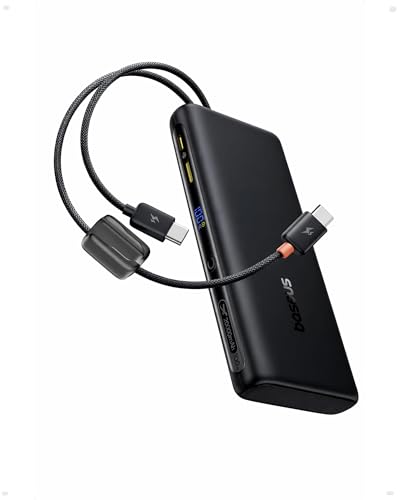
The Baseus 100W occupies a compelling middle ground between the phone-focused Anker Zolo and the premium Anker 737. It costs less than half the price of the Anker 737 while still delivering 65W USB-C Power Delivery, which is enough to charge most ultrabooks and all smartphones at full speed. The digital display is a practical touch that shows remaining capacity at a glance. Pass-through charging works well here, meaning you can charge the Baseus from a wall outlet while simultaneously charging your phone from the Baseus. This is particularly useful in hotels where outlets are scarce. It is heavier than a phone-only charger, but that is the unavoidable trade-off for laptop-level power delivery.
The INIU is the least expensive power bank in our guide, and it punches well above its price point. The triple output lets you charge three devices at once, which is unusual at this price. The built-in flashlight is a genuinely useful bonus for navigating dark hostels or campgrounds. The 10,000mAh capacity covers about two full phone charges, which is enough for a full day of sightseeing. The honest limitation is charging speed. Without USB-C PD, you get standard charging rates that are noticeably slower than the Anker Nano or Baseus. If you primarily need a safety net for emergencies and overnight top-ups rather than rapid mid-day refueling, the INIU delivers excellent value.

The MagGo is a niche product that absolutely nails its niche. If you own an iPhone 12 or newer, the magnetic attachment transforms how you think about portable charging. You snap it onto the back of your phone, and it stays there securely while you walk, photograph, or navigate. No cables required. The built-in kickstand doubles as a phone stand for watching content during layovers or propping up your phone for video calls. The 5,000mAh capacity is modest, providing roughly one additional full charge for most iPhones, but that is by design. This is meant to be ultralight and unobtrusive. The clear limitation is compatibility: this is an iPhone-only product, and wireless charging is inherently slower than wired. Android users and anyone needing serious capacity should look elsewhere.

All six portable chargers compared across the specs that matter for travel.
| Product | Capacity | Output | Weight Class | Best For | Price |
|---|---|---|---|---|---|
| Anker Nano 10K | 10,000mAh | 30W USB-C | Pocket-sized | Most travelers | $59.99Amazon price as of Oct 8, 2026, 12:01 PM UTC. Details |
| Anker Zolo 20K | 20,000mAh | 30W USB-C, built-in cable | Medium | Long trips, value seekers | $42.99Amazon price as of Oct 8, 2026, 12:01 PM UTC. Details |
| Anker 737 24K | 24,000mAh | 140W USB-C | Heavy | Laptops, digital nomads | |
| Baseus 100W 20K | 20,000mAh | 65W USB-C | Medium-heavy | Budget laptop charging | $55.99Amazon price as of Oct 8, 2026, 12:01 PM UTC. Details |
| INIU 10K | 10,000mAh | Triple USB-A | Pocket-sized | Budget travelers | $20.89Amazon price as of Oct 8, 2026, 12:01 PM UTC. Details |
| Anker 622 MagGo | 5,000mAh | 7.5W Wireless | Ultra-light | iPhone users | $35.99Amazon price as of Oct 8, 2026, 12:01 PM UTC. Details |
Milliamp-hours (mAh) is the standard unit for battery capacity, but the number on the box never tells the full story. Due to energy lost as heat during voltage conversion, you should expect roughly 60-70% of the rated capacity to actually reach your device. Here is what each capacity tier delivers in the real world:
The type of port on your power bank determines how fast your devices charge. This matters more than most people realize, especially when you have a 45-minute layover and your phone is at 8%.
Pro tip: Always use the highest-wattage cable and port combination available. A 30W power bank paired with a cheap USB-A cable will charge at USB-A speeds, not 30W. Invest in a quality USB-C to USB-C cable.
Lithium-ion battery regulations are taken seriously by every airline. Getting this wrong can mean having your power bank confiscated at security or, worse, being denied boarding. Here are the rules that apply worldwide:
Important: Some budget airlines in Asia and the Middle East enforce stricter limits (as low as 20,000mAh regardless of Wh rating). Check your specific airline's policy before traveling with a high-capacity power bank.
Beyond raw capacity and charging speed, several features genuinely improve the travel experience:
Yes, but only in your carry-on luggage. Airlines prohibit power banks in checked baggage because lithium-ion batteries pose a fire risk in the cargo hold. Most airlines allow power banks up to 100Wh (roughly 27,000mAh at 3.7V) without prior approval. Power banks between 100Wh and 160Wh typically require airline approval before boarding. All six chargers in our guide fall within the 100Wh limit and are approved for carry-on on every major airline worldwide.
A 10,000mAh power bank will charge most modern smartphones about 1.5 to 2.5 times, depending on your phone's battery size and the efficiency loss during charging. An iPhone 15 (3,349mAh) gets roughly 2 full charges, while a Samsung Galaxy S24 Ultra (5,000mAh) gets closer to 1.5 charges. Energy conversion is never 100% efficient—expect about 60-70% of the rated capacity to actually reach your device due to voltage conversion and heat loss.
USB-A ports typically deliver 5-12W of power and charge your phone at standard speed. USB-C with Power Delivery (PD) can deliver 20-140W, which means dramatically faster charging. With USB-C PD at 20W or higher, you can charge an iPhone from 0-50% in about 30 minutes. At 65W and above, you can charge laptops like MacBook Air and most ultrabooks. If you carry a modern smartphone, USB-C PD is worth the premium for the time savings alone.
Recharge time depends on the power bank's capacity and the charger you use. A 10,000mAh power bank takes about 2-3 hours with a 20W USB-C charger, or 5-6 hours with a basic 5W charger. A 20,000mAh unit takes 4-6 hours with USB-C PD input, or up to 10 hours with USB-A. The Anker 737 (24,000mAh) can recharge in about 90 minutes using its included 140W input, which is remarkably fast for its capacity. Always recharge your power bank the night before travel.
For most travelers, 20,000mAh is the sweet spot. It provides 4-5 full phone charges, enough to keep a smartphone running for 3-4 days of heavy use without access to a wall outlet. That covers long-haul flights, layovers, and full days of sightseeing with GPS navigation running. If you also need to charge a tablet or laptop, consider the 24,000mAh Anker 737 or the Baseus 100W, which offer high-wattage output alongside generous capacity.
Yes, all lithium-ion batteries experience self-discharge over time, but the rate is very slow. A quality power bank loses about 1-2% of its charge per month when sitting idle. If you fully charge a power bank and leave it in a drawer for three months, it will still have about 94-97% capacity. For best battery longevity, store your power bank between 20-80% charge in a cool, dry place. Avoid leaving it fully charged or fully depleted for extended periods.
Pass-through charging allows you to charge your phone (or other device) from the power bank while the power bank itself is plugged into a wall outlet. It essentially turns your power bank into a multi-port wall charger. This is incredibly useful in hotels with limited outlets or at airports where you find a single available plug. Most quality power banks from Anker and Baseus support this feature. The Baseus 100W and Anker 737 both offer excellent pass-through performance.
Can't find what you're looking for? Explore more options directly on Amazon.
As an Amazon Associate we earn from qualifying purchases
Check out our tech travel gifts guide for more gadgets every traveler needs.
View Tech Gifts
Founder & Editor-in-Chief
Taro spent a decade in the music industry as a tour manager, crisscrossing the globe with artists and crews who demanded gear that actually worked. From overnight buses in the American Midwest to bullet trains in Japan, backstage in London to festival grounds across Europe—he's lived out of bags, cases, and carry-ons for years. That experience taught him what separates travel gear that survives the road from stuff that falls apart after one trip. Now he channels that hard-won knowledge into TravelGiftList, helping travelers find products that meet real-world demands.
Credentials
