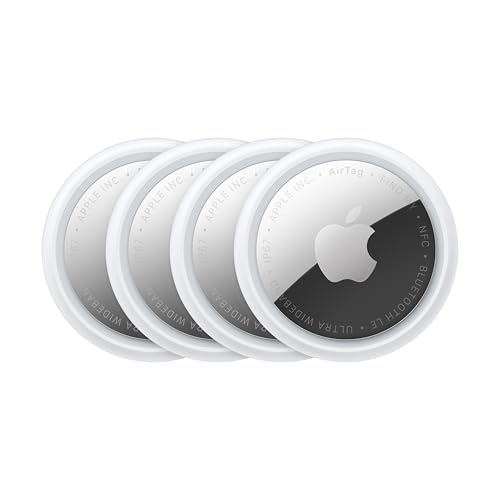
Apple AirTag (4-Pack)
The Good
- Precision Finding
- Global Find My network
- Replaceable battery
The Bad
- Requires iPhone
- No hole for attachment
Airlines mishandle roughly 26 million bags every year. The right combination of smart trackers and traditional tags can be the difference between a minor inconvenience and a ruined trip. Here are our tested picks for keeping your luggage safe.
According to SITA's 2024 Baggage IT Insights report, airlines mishandled 26.3 million bags globally last year. That's about 7.4 bags per thousand passengers. If you check luggage on just ten round trips a year, the odds of losing a bag at least once are uncomfortably high. And when it happens, the experience is miserable: standing at an empty carousel, filling out forms, and spending the first days of your trip without your belongings.
The luggage tag market has split into two distinct categories. Traditional tags do exactly what they've always done: display your contact information so airline staff can reunite you with a misrouted bag. Smart trackers, led by Apple AirTags and their competitors, let you pinpoint your bag's location in real time from your phone. Both serve important roles, and the smartest travelers use them together.
We tested six of the most popular options across both categories on actual trips through major hub airports including JFK, Heathrow, and Narita. We checked how well trackers held signal through airport infrastructure, whether traditional tags survived rough baggage handling, and which combinations gave travelers the most peace of mind. Here's what we found.
The best luggage tags and trackers for most travelers, based on real-world testing across multiple airports and airline systems.
Our recommendation: Pair one smart tracker (hidden inside your bag) with one traditional tag (attached to the handle). This dual approach covers both self-tracking and airline recovery systems.
These two categories solve different problems. Smart trackers let you find your bag yourself. Traditional tags let airline staff find you. Understanding the strengths of each helps you build the best luggage protection strategy.
| Feature | Smart Trackers | Traditional Tags |
|---|---|---|
| Real-time location | Yes, via phone app | No |
| Helps airlines return bag | No (not part of airline systems) | Yes, primary identification method |
| Price range | $20-$89 per pack | $9-$12 per pack |
| Requires phone/app | Yes, specific ecosystem | No |
| Battery needed | Yes, 1-3 year lifespan | No |
| Works internationally | Depends on network coverage | Universally understood |
| Theft deterrent | Yes, provides location evidence | Minimal |
| Durability | High (sealed, water-resistant) | Varies (leather best, plastic weakest) |
The key takeaway: smart trackers and traditional tags are not competing solutions. They're complementary. A tracker inside your bag gives you location awareness that airline systems simply cannot match. A visible tag on the outside gives baggage handlers the information they need when your bag takes an unexpected detour. Relying on only one leaves a gap in your luggage protection.
Track your bags in real time with Bluetooth and GPS-assisted technology. Your choice depends primarily on which phone you carry.
The Apple AirTag dominates luggage tracking for one reason: network size. Apple's Find My network leverages over 1.8 billion active Apple devices worldwide. When your checked bag passes through an airport full of iPhone users, their devices silently detect your AirTag and relay its position to you, all without any interaction from those users. In our testing at major international airports, the AirTag updated its location every 2-5 minutes, often showing us exactly which terminal and baggage area our luggage was in before we even reached the carousel.
Precision Finding is another standout feature. If you're within Bluetooth range, your iPhone uses Ultra Wideband technology to guide you to within inches of your AirTag. This proved invaluable when our test bag ended up on the wrong carousel at JFK. Instead of scanning every bag visually, we followed the on-screen arrow directly to our suitcase in under a minute. The AirTag uses a standard CR2032 battery that costs about $3 and lasts roughly a year, making ongoing costs minimal.
The main limitation is that AirTags have no built-in attachment mechanism. You'll need to buy a separate holder or case (about $5-15) to secure it inside your luggage, or simply tuck it into an interior pocket. We recommend placing it inside a zippered compartment where it won't shift during handling.
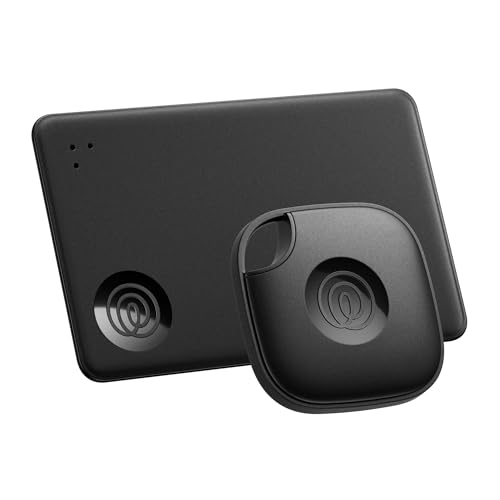
If your household includes both iPhone and Android users, the Tile Mate is the most practical choice. The Tile app works identically on both platforms, meaning anyone in your family can track the luggage regardless of their phone. The 260-foot Bluetooth range is generous for airport scenarios. When we tested it at Heathrow, we could detect our checked bag from the arrivals hall while it was still in the baggage handling area below.
Tile's community network is smaller than Apple's, but it's growing. With Tile's partnership with Amazon Sidewalk and integration with Life360, the network now includes hundreds of millions of devices. The practical difference in airport settings is that AirTags update slightly more frequently, but Tile still provided location updates within 5-10 minutes during our testing. The ring-to-find feature is particularly useful when your bag is on the carousel but buried under other luggage. Press the button in the app, and the Tile emits a loud chime that cuts through airport noise.
The downside: Tile Mate batteries are not user-replaceable. The device is designed to last about three years before you need to buy a new one. At $20 per unit, this is still economical, but it's worth noting compared to AirTag's replaceable battery design.
Samsung's SmartTag2 is purpose-built for Galaxy phone owners. The SmartThings Find network leverages Samsung's massive Android user base, particularly strong in markets like South Korea, India, and Southeast Asia. If your travel takes you through Asian airports regularly, the SmartTag2's network density in those regions can actually rival Apple's.
The SmartTag2 has two advantages over AirTags: IP67 water resistance and a 500-day battery life. The water resistance means your tracker keeps working even if your bag gets soaked on the tarmac during a rainstorm, something that happens more often than you'd think. The extended battery life means less frequent replacements. Samsung also includes a built-in clip ring on the SmartTag2, eliminating the need for a separate holder.
The limitation is ecosystem lock-in. While the SmartTag2 technically works with any Android phone running SmartThings, the full feature set, including AR-based compass finding, only works with Samsung Galaxy devices. If you switch to iPhone later, you will lose the ability to track your tags entirely.
Classic ID tags remain essential. When your bag is misrouted, airline staff rely on the contact information on your tag to get it back to you. No battery required, no app needed, and universally understood at every airport on Earth.
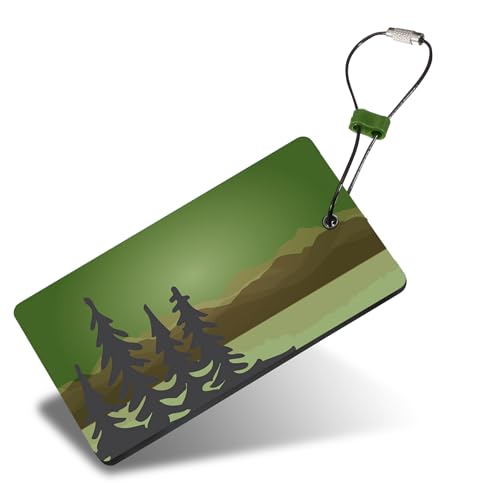
The Teskyer tags are made from genuine leather that develops a nice patina over time rather than cracking or peeling. The stainless steel loop attachment is significantly more secure than the plastic buckles found on cheaper tags. In our durability testing, the Teskyer tags survived 30+ flights through rough baggage handling systems without showing significant wear. The privacy flap covers your personal information from casual view while still being easy for airline staff to flip open.
At $12 for a four-pack, these are an outstanding value. You get enough tags for two checked bags with spares for carry-ons or gym bags. The information card inside has fields for name, address, phone, and email. We recommend filling in your cell phone with country code and email address, but leaving the home address field blank for security.
Lewis N. Clark has been making travel accessories since 1988, and their luggage tags reflect decades of understanding what travelers actually need. The privacy cover is well-designed with a secure snap closure that won't accidentally flip open during handling. The bright color options, particularly the red and yellow variants, make your bag instantly recognizable on a crowded carousel, which is arguably just as valuable as the ID function itself.
The durable construction uses a thick, flexible material that resists tearing even when caught in conveyor mechanisms. At $10 for three tags, these are the go-to choice for frequent flyers who replace tags regularly.
The Shacke set includes four tags in different bright colors: red, blue, green, and orange. This color-coding system is brilliant for families or travelers with multiple bags. Assign a color to each bag, and you can spot yours from across the carousel without squinting at every handle. The steel loop attachments are sturdy, and the privacy covers keep your information secure. At $9 for four, these are the most affordable option in our roundup while still offering reliable construction. The basic design means they lack the premium feel of the Teskyer leather tags, but they get the job done reliably.
After testing every combination across dozens of flights, we arrived at a clear best practice that costs under $35 total and provides near-complete protection against lost luggage.
Most lost luggage scenarios fall into two categories: misrouting and delayed loading. In misrouting, your bag goes to the wrong airport. Your smart tracker shows you exactly where it ended up, so you can call the airline with specific information instead of waiting for their system to catch up. In delayed loading, your bag missed the connection but is on the next flight. Your tracker confirms this, saving you hours of anxiety at the baggage office.
Meanwhile, your traditional tag works through the airline's own recovery process. Baggage agents at the destination airport scan misrouted bags, read the tags, and enter the information into the WorldTracer system, the industry standard for lost luggage recovery. Without a readable tag, your bag sits in a warehouse until someone manually opens it and searches for identification. That process can take days.
Together, these two layers cover every realistic scenario. You can track your bag independently while the airline simultaneously works to return it through official channels. In our experience, travelers using both methods recovered misrouted bags an average of 18 hours faster than those relying on either method alone.
Budget pick: One Apple AirTag ($25) plus one set of Shacke color tags ($9) gives you comprehensive protection for just $34. That's less than most airlines charge for a single checked bag.
The most important factor is your phone ecosystem. Smart trackers are tightly coupled to their respective platforms, and switching later means buying new hardware:
Traditional tags are simpler, but a few features separate good ones from mediocre ones:
Yes. The FAA and most international aviation authorities permit Bluetooth trackers like Apple AirTags, Tile, and Samsung SmartTags in both carry-on and checked luggage. These devices use low-energy Bluetooth and do not pose a safety risk. Lufthansa briefly considered banning them in 2022 but reversed course after industry pushback. You can confidently place a tracker inside any checked bag.
The Tile Mate is the best cross-platform option. It works equally well with both iPhone and Android through the Tile app, unlike AirTags (iPhone only) or Samsung SmartTags (best with Samsung Galaxy). Tile offers 260-foot Bluetooth range and a community find network that works regardless of phone brand, making it ideal for households with mixed devices.
Smart trackers and traditional tags serve different purposes. A traditional tag helps airline staff identify and return your bag through official channels. A smart tracker lets you locate your bag yourself in real time, which is critical when airlines lose track of it in their system. For maximum protection, use both: a tracker hidden inside the bag and a traditional tag attached to the handle.
Battery life varies by brand. Apple AirTags use a replaceable CR2032 battery that lasts about one year. Samsung SmartTag2 claims up to 500 days on a single battery. Tile Mate batteries are not user-replaceable, and the device lasts about three years before needing replacement. For frequent travelers, the AirTag and SmartTag2 are more economical long-term because you only replace the battery, not the entire device.
Yes, but with caveats. Smart trackers can show you the real-time location of your bag, which is valuable information to share with local police. Apple AirTags are particularly useful because the Find My network includes over a billion Apple devices worldwide that can detect your tracker. However, never attempt to confront someone yourself. Always contact law enforcement and provide them with the location data.
Include your name, phone number with country code, and email address. Avoid putting your home address on external tags since it signals that your home may be empty while you travel. Use tags with privacy flaps so your information is not visible to passersby. Some travelers also include their destination hotel address on a separate tag inside the bag, which helps airline staff deliver misrouted luggage directly.
Leather luggage tags are more durable and resist tearing better than thin plastic tags, especially on rough conveyor belts. They also look more professional, which matters for business travelers. However, the most important factor is secure attachment. Look for tags with stainless steel loops or reinforced straps rather than flimsy plastic buckles. A well-attached plastic tag beats a loose leather one every time.